
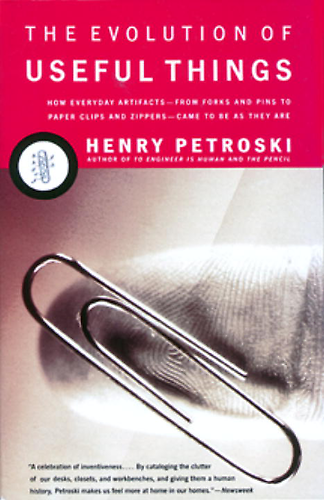
 I love reading and I tend to read a lot of non-fiction among fiction. I also have a fascination with cognitive science, the human mind and why things happen. So naturally when I stumbled on Henry Petroski’s The Evolution of Useful Things it was quite intriguing.
The book dove into the fascinating world of how normal household items became the way they are today. He talked about such things as forks, pins, paper clips and zippers which we don’t normally think much about. There’s even parts on pop cans and the wrapper for your McDonald hamburgers.
The book really did dig into my curiosity of things. It was a great read, but I always felt like there was something missing in the book. Then when I finished it, I realized what it was. The book was published in 1992.
Who knows, maybe it was even written a bit before that but my point is in the past 10 years we’ve seen a drastic change in technology. Some of the things in the book hardly exist any more. Petroski talked about the VCR as if it was just new. Does anyone have any of those any more? In this increasingly digital world, is there even use for paper clips besides the one that helps you in Microsoft Word? Does he even exist any more?
It’s fascinating how quickly things have moved in the past 10 years. Petroski’s theories on how things evolve still apply though, so I am going to look at some of them and how they apply to the world today.
1. Form Follows Failure
This is a pretty self-explanatory section on how things changed in looks to better improve its use. 10 years ago there were probably those giant cellphones that looked like this:

Now they come in tons of tiny pocket sizes. Not to mention the iPhone which is many devices in one device.
2. Inventors as Critiques
Nowadays we don’t even have just inventors just being critiques of products. We have the consumers. We have the people at Tech Crunch, IMDB or the 1000 of blogs that critique every product (and place) in the world. It’s a world of free advice on improvement. It is probably one of the biggest reasons why things have evolved so quickly in the internet age. You know exactly what people want and it’s a race to see who can make it first.
3. One Thing Comes From Another
This is a self explanatory chapter on how one invention probably came from another. Out of the knife came a fork. Out of a camera became the digital camera, the lenses that accompany it, the flash, the bag, the printers that print pictures. It’s amazing the amount of things that develop from other things. Will we have flying cars in the future?
4. Closure Before Opening
In this section Petroski discussed how tin cans were invented before someone invented the can opener. I feel like this can be applied to mp3 players. Remember before the iPod, there were all sorts of strange mp3 players, including Sony’s Mini Disc player? All these were created before an effective system to sell you digital music was even implemented. Back then, the only way to fill them was to rip CDS or to of course, illegally download music. It wasn’t until Steve Jobs created iTunes that an effective system was in place, and now he controls both, the player and the content.
5. When Good Is Better Than Best
Remember the days when McDonalds had styrofoam packaging? Maybe you’re too young. They actually used to keep your burger warmer than the paper packaging of today. But guess what? They were horrible for the environment. We’ve become increasingly environmentally aware in creating new products but the reality of them is that they are not always better than the alternative. I sure as hell know that those energy saving light bulbs don’t light up a room the same way the others do. I always want to fall asleep in rooms lit up energy efficiently. My parents just installed water-saving toilets throughout the house. They don’t always flush down all your droppings.
6. Patterns of Proliferation
New inventions are always scary to people and none become successful until they are wildly used. When the iPod developed in 2001, who would have thought it would grow to the capacity it has now? Who would have thought MySpace would disappear? As things become more widely used, they become the norm. Why are most phones touch screen now? Because Apple made it cool. I hope in my lifetime I can grab the chocolate bars on TV.
7. Domestic Fashion and Industrial Design
Apple is probably the best example of how design matters in choosing what to buy. Everything from their products, their packaging to their store has been thought out (not to mention patented). We’re constantly buying what “looks” most current. I am writing this post as I am sitting in my kitchen of stainless steel appliances. Why do we have them? Because they look like the future.
All in all, it was an interesting book and an great way to see how things have evolved and will evolve. Now excuse me while I work on inventing my teleportation device.
 Tiana Feng
Did you read “A Brief History Of Everything” by Bill Bryson? Basically, it’s a potted history of science and technology but very enjoyable.
Rob.
Oo, if I can find it I’ll definitely check it out!
Very cool! It was a pleasure to share this all around – even on Digg! I absolutely love articles like this – well done!
:) thanks so much for sharing!